



What is the Talent Demand and Salary for Banking & Financial Services Professionals in Malaysia?
Amidst a bleak global economic outlook caused by concerns for an upcoming recession, the Asian banking sector remains resilient carving out a positive niche for itself amidst turbulent international conditions. Among their peers, Fitch ratings maintained a positive outlook towards Malaysian banks, which are projected to enjoy solid financial performance over the next 12-18 months, thanks to a supportive domestic market offering stable growth prospects amid manageable credit risks.
Worldwide, digital banks have been growing in popularity among users for providing a seamless, trouble-free digital on-boarding process. This is especially true in Asia where a fifth of the world’s digital banks current predict, offering contemporary, cloud-driven architecture, exceptional user engagement, and a readiness to integrate their financial services into existing platforms to the tune of user engagement.
This trend is set to continue in Malaysia, where 74 percent of Malaysians utilise digital financial services and 79 percent use digital payments. To promote financial inclusivity, Bank Negara Malaysia has awarded five digital banking licenses to applicants, the first of which was approved for operations in September 2023. This expanding blue ocean market is expected to result in an influx of job openings for adventurous candidate’s looking to break into the digital banking sector. The job demand for students intending to study Banking & Finance, Accounting & Finance, and Finance remains positive and a good choice. However, students need to factor in the impact of technology on financial services hence should look for courses that have a technology focus such as Financial Technology (Fintech).
Banking & financial services
Key trends

Darren, Finance & Investment Graduate from UCSI University
- The booming fintech sector is fueling strong demand for specialised tech roles such as product development, product management lifecycle, data analysts, and UI/ UX specialists. Candidates with cross-functional skillsets across finance and tech will be in especially high demand. Demand for senior and middle management level talent is also healthy while demand for lower-skilled and routine-based roles has weakened, with some of them being replaced by technology.
- As the financial sector evolves, the roles and skills required will transform in tandem. Moving forward, this sector needs to be more adaptive and responsive to cope with continued economic, technological and societal disruptions. This will require a workforce that can learn, apply, and deploy emerging business models and technologies swiftly.
- Just hiring new talent to fill the needs will not be enough though. Employers must invest in upskilling and learning programmes for the workforce to ensure there is suitable talent available both industry-wide and at every level of the organisation.
Expected salaries
What is the Salary for Banking & Finance Professionals in Malaysia?
A relationship manager in private(IB)/premier/preferred/priority banking at the AVP level (eight to 12 years of experience) can earn between RM10,000 and RM15,000 a month; while an internal auditor at the SVP level (15 years and above of experience) can earn between RM25,000 and RM35,000.
Accounting and finance
| Role | Min (RM) | Max (RM) |
| Chief Finance Officer (MNC) | 40,000 | 75,000 |
| Finance Director | 25,000 | 40,000 |
| Senior Accountant | 10,000 | 15,000 |
| Accountant | 8,000 | 12,000 |
| Senior Accounts Executive | 5,000 | 6,500 |
| Finance Manager | 10,000 | 15,000 |
Banking and financial services
| Role | Min (RM) | Max (RM) |
| Managing Director, Corporate Finance | 35,000 | 50,000 |
| Director | 25,000 | 35,000 |
| Vice President | 18,000 | 25,000 |
| Head of Investment/Chief Investment Officer | 35,000 | 50,000 |
| Head of Research | 25,000 | 35,000 |
| Regional/District Manager, Consumer Banking | 12,000 | 16,000 |
Finance & accounting
Key trends

Chun Tim, Foundation in Business into Finance at Taylor’s University
- Per the findings, Malaysia’s popularity as a hub for shared service centres and rapid developments in the financial services and fintech space has contributed to the relative stability as well as the steady stream of opportunities in the accounting & finance sector during the pandemic.
- However, the trends have changed post-pandemic; for businesses to remain resilient and competitive, employers need accounting and finance professionals who are able to do more than crunch numbers, but also interpret the reports and provide insights for solutions. On one hand, the digital revolution is impacting this sector while on the other, the challenging business environment requires agility and insightful analytical skills from the talent.
- As such, finance and accounting roles are no longer limited to tedious tasks such as bookkeeping.
- Manual processing and tracking of transactions are being replaced by advanced tools such as cloud-based accounting, blockchain and software solutions which can process vast volumes of data in a short time thus greatly improving efficiency.
- Technology such as AI and big data analytics tools will also enable better financial forecasting and modelling.
Expected salaries
The chief financial officer of an MNC, who brings with them 15-20 years of experience, could be looking at a pay of RM40,000 to RM75,000 a month, while a finance director with the same number of years of experience could be looking at around RM25,000 to RM40,000.
Overall:

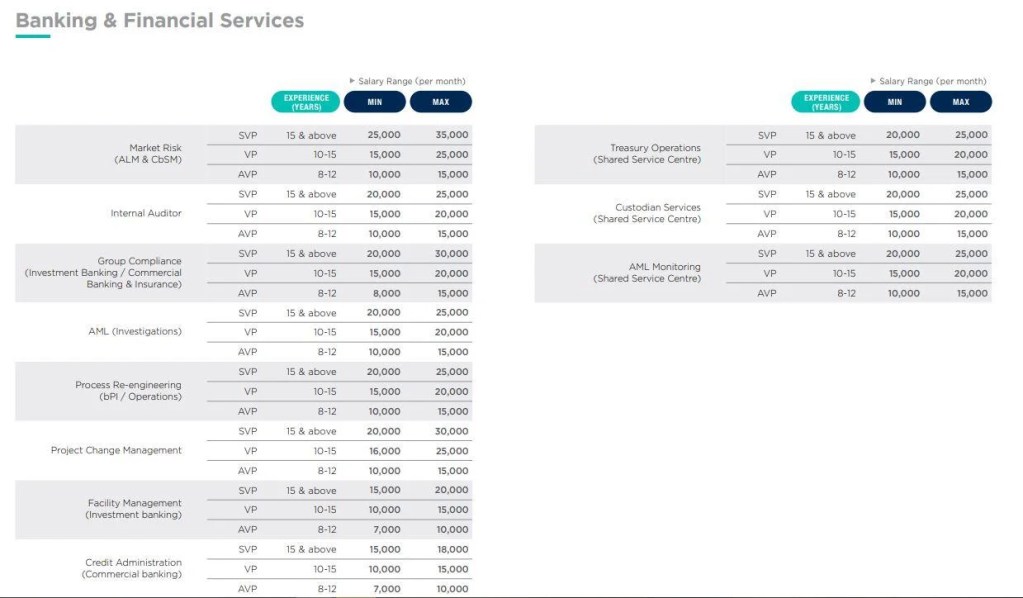
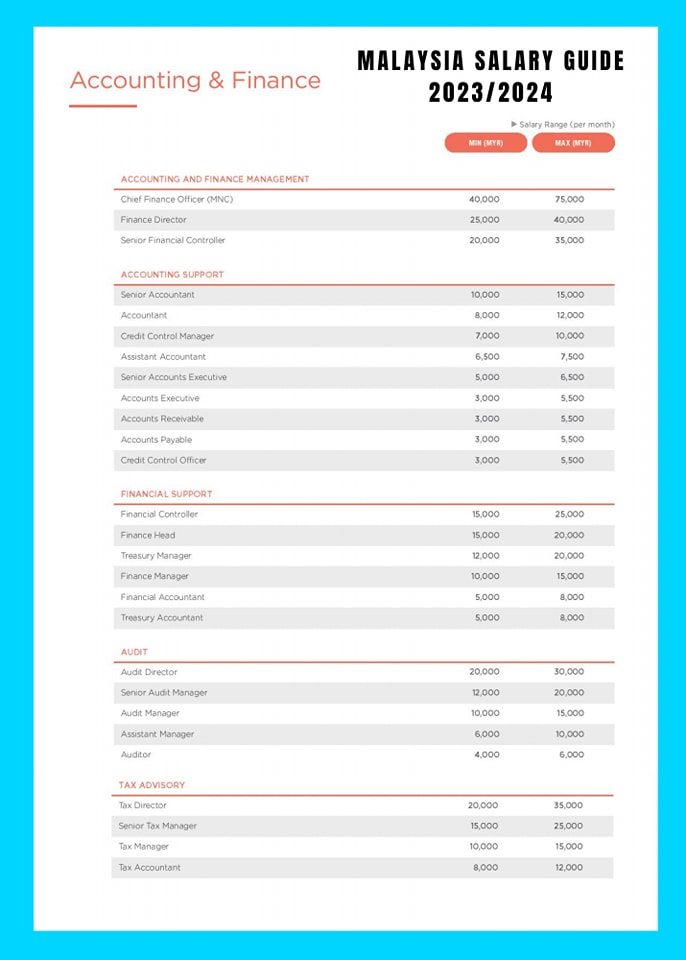
– Finance & Accounting
Source: Persolkelly Malaysia
.
Malaysian banking and financial services has embraced the future of technology

Bryan & Wen Kai, Fintech at Asia Pacific University (APU)
While local economy contributes much to the success of this critical sector, there is also much to be said about the flexibility Malaysian banks have taken in their approach towards updating their processes to be future-ready. Malaysian consumers today now enjoy a variety of digital-ready products and services that make the banking process much easier.
On paper, these innovations are being seen as a step towards bridging the gap between two important segments of the population. First of these are rural communities with limited access to physical banks benefit greatly from the availability of online services, allowing them to perform transactions without the hassle of traveling long distances to visit an outlet.
But technology benefits more than just marginalised groups. These innovations are crucial for appealing to a new generation of users that are embracing the digital world more keenly than ever before. From simple utilities such as being able to transact via mobile devices to integrated payment functions linking vendors to customer with QR codes, Malaysian banks are doing what they can to market themselves to Gen-Z as institutions that cater to their unique needs.
Malaysian banks are adopting artificial intelligence faster than ever

As the world of work continues to evolve at a breakneck pace, flexibility has become a key component for organisations sourcing for the right talent to support their operational needs. Nowhere does this feel more pronounced than in the tightly regulated banking and financial service industry, where necessary change is fought for at every step of the way.
Leading this change is AI and automation technology, which Malaysian banks have been quick to adopt to. Ever since homegrown CIMB introduced the first conversational real-time chatbot for commercial banking, an increasing number of banks have been introducing their customers to automation solutions, giving them quick and convenient access to information and services.
But at the very centre of it all, banks understand the need to maintain a human touch in their strategy. Today, front office positions are in high demand, with many banks looking to secure existing staff by offering large salary increments and associated benefits. This is supported by robust hiring strategies to fill vacancies, as financial institution look towards building a better candidate experience to entice applicants.
Where AI adoption has not yet seen heavy use is in the talent recruitment space. The candidate acquisition process is still very much a traditional one, with a preference towards internal acquisition teams, agencies or referral programs.
Digital Banking is growing in Malaysia

Aaron Wong, MA Business & Finance at Heriot-Watt University Malaysia
Worldwide, digital banks have been growing in popularity among users for providing a seamless, trouble-free digital on-boarding process. This is especially true in Asia where a fifth of the world’s digital banks current predict, offering contemporary, cloud-driven architecture, exceptional user engagement, and a readiness to integrate their financial services into existing platforms to the tune of user engagement.
This trend is set to continue in Malaysia, where 74 percent of Malaysians utilise digital financial services and 79 percent use digital payments. To promote financial inclusivity, Bank Negara Malaysia has awarded five digital banking licenses to applicants, the first of which was approved for operations in September 2023. This expanding blue oceana market is expected to result in an influx of job openings for adventurous candidate’s looking to break into the digital banking sector.
What banking and financial services roles are in demand in Malaysia?

Paul Kit, Finance at UCSI University
The banking and financial services sector in Malaysia remains job rich, especially in wealth and asset management, as well as the commercial banking sector. Recruitment remains strong especially for relationship management and credit analysis roles where banks are still on the lookout for frontline staff.
There are also gaps that have proven particularly difficult to fill in specialties that have grown in importance over the years. ESG and Sustainability roles continue to lack suitable candidates with the prerequisite skill sets across the market, despite organisation seeing more value in fulfilling these functions. Back-office functions are also short on candidates with programming skills, while risk managers continue to be a rarity among talent pools. Technical data modelling skills have also proven particularly difficult to find in qualified candidates.
In an evolving market like banking and financial services, we understand the importance of having quick access to top talent who will make a real difference. We have spent years nurturing an ecosystem of highly engaged and unique candidates and will work with you to grow or scale your business using our unique expertise aligned to sectors and technologies. Be sure to reach out to us if you have a position that needs fulfilling.
What are Malaysian employers doing to find talent in banking and financial service?

Vincent Yeoh, Accounting & Finance at Asia Pacific University (APU)
The competitive nature of the banking and financial service industry means that candidates are well compensated in comparison to their peers in other industries. While candidates can expect to earn comparatively higher salaries when they start out, this increment begins to taper off as employees approach the five-year make at their place of employment.
Financial institutions are taking advantage of this by offering prospective candidates largest increments by switching over from their competitors. Candidates who make this career shift can generally see a 20-30% bump in salary, compared to 2-5% if they had stayed on with their previous employer.
Areas of Finance that will be in Demand
- With companies recognising the importance of business continuity plans amid crises, a lot of focus will be placed on hiring for roles related to risk management, compliance, and business continuity planning in 2023.
- Hybrid roles combining finance and IT will be highly sought after, as organisations have recognised the value of collaboration for greater output and productivity. In finance shared services, there will be demand for professionals proficient in master data who are also eloquent in foreign languages such as Vietnamese, Japanese, Thai, and Korean.
- Demand for finance business partners in Financial Planning & Analysis (FP&A) roles will remain high, as it is very important to have solid finance business partnering abilities to communicate and support other departments effectively.