


Best Private Universities in Malaysia to Study a Top Information Technology (IT) Degree Programme
Information technology (IT) is the application of computers to store, study, retrieve, transmit, and manipulate data, or information, often in the context of a business or other enterprise. IT is considered a subset of information and communications technology (ICT). The Information Technology (IT) in Malaysia sector is exceptionally diverse and continues to grow. IT professionals often move between professional specialisations as their interests and expertise grow and change. Graduating with a Information Technology (IT) degree from a top private university in Malaysia allows you to choose from a wide range of careers in software development, business analysis, ITC consulting, data modelling, systems integration and network management.
According to a report, the job prospects for information technology (IT) professionals in Malaysia is very good and well trained ICT professionals can earn a high salary. It is important to choose the best university in Malaysia to study the Information Technology (IT) diploma or degree course so that you can gain vital knowledge and skills to succeed in your career.
What is Information Technology and Studying IT at the Best Universities in Malaysia
Information Technology (IT) involves many things. Take, for instance, an IT department in a company in Malaysia where there are many people with many jobs and a variety of responsibilities. These responsibilities range from keeping systems and data secure to keeping networks up and running. There are people who input data, people who manage databases and people who do programming. There are also the decision makers, such as Chief Information Officers (CIOs), who decide how an IT department will operate and what components will be purchased.
Information Technology (IT) also includes the management of data, whether it is in the form of text, voice, image, audio or some other form. It can also involve things related to the Internet. This gives IT a whole new meaning, since the Internet is its own realm. Information Technology (IT) involves the transfer of data, so it makes sense that the Internet would be a part of IT. IT has become a part of our everyday lives and continues to proliferate into new realms.
Typically, Information Technology (IT) is used in the context of enterprise operations as opposed to personal or entertainment technologies. The commercial use of IT encompasses both computer technology and telephony.
The term information technology was coined by the Harvard Business Review, in order to make a distinction between purpose-built machines designed to perform a limited scope of functions and general-purpose computing machines that could be programmed for various tasks. As the IT industry evolved from the mid-20th century, it encompassed transistors and integrated circuits — computing capability advanced while device cost and energy consumption fell lower, a cycle that continues today when new technologies emerge.
Information Technology (IT) Software and Hardware

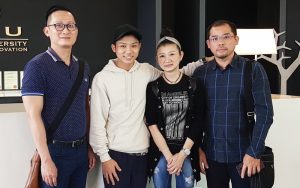
Cavan Stefan, IT at HELP University
IT includes several layers of physical equipment (hardware), virtualization and management or automation tools, operating systems and applications (software) used to perform essential functions. User devices, peripherals and software, such as laptops, smartphones or even recording equipment, can be included in the IT domain. IT can also refer to the architectures, methodologies and regulations governing the use and storage of data.
Business applications include databases like SQL Server, transactional systems such as real-time order entry, email servers like Exchange, Web servers like Apache, customer relationship management and enterprise resource planning systems. These applications execute programmed instructions to manipulate, consolidate, disperse or otherwise affect data for a business purpose.
Computer servers run business applications. Servers interact with client users and other servers across one or more business networks. Storage is any kind of technology that holds information as data. Information can take any form including file data, multimedia, telephony data and Web data, data from sensors or future formats. Storage includes volatile random access memory (RAM) as well as non-volatile tape, hard disk and solid-state flash drives.
Information Technology (IT) architectures have evolved to include virtualization and cloud computing, where physical resources are abstracted and pooled in different configurations to meet application requirements. Clouds may be distributed across locations and shared with other IT users, or contained within a corporate data center, or some combination of both deployments.
Studying the Best Information Technology or Computing Courses at Top Private Universities in Malaysia

Qi Leem, Software Engineering Graduate from Asia Pacific University (APU)
Most top private universities in Malaysia offer a selection of Foundation, Diploma & Degree courses in information technology (IT) or computing.
Graduating with a Information Technology (IT) degree from a top private university in Malaysia allows you to choose from a wide range of careers in software development, business analysis, ITC consulting, data modelling, systems integration and network management.
Students after SPM or O-Levels will have 2 options to choose from which are the Foundation in Computing & Technology and the Diploma in Information Technology. Both pathways to the degree will take a total of 4 years in duration.
The Foundation is a 1-year course and is more academic in nature while the Diploma takes 2 years to complete and is more practical. With the Diploma, you can either continue on to the degree after completion or go to work. On the other hand, upon completing the Foundation, you will need to enter into the degree course for another 3 years. You cannot use the Foundation qualification to find a job.
The subjects offered in both Foundation and Diploma cover topics related to information technology which is an advantage compared to taking an external Pre-University course. However, the subjects in Foundation and Diploma cover a wide range of information technology areas. You will only specialise during your degree studies. You can take the time during your Foundation or Diploma to decide which area to specialise in for your IT degree.
As you may well know, information technology (IT) is used interchangeably and can mean software engineering, computer science or other computing courses. After taking the variety of computing subjects in the Foundation and Diploma, you will get a better idea of which area that you would like to specialise in. A degree in information technology will take you 3 years to complete.
When choosing an IT degree programme to study, it is important to look at the subjects to see if they match your academic and career goals. The university also plays an important part in developing your knowledge and skills so take the time and effort to research for the right one.
Information Technology (IT) Education and Job Functions in Malaysia
A team of administrators and other technical staffers deploy and manage the company’s IT infrastructure and assets. IT teams depend on a wide range of specialized information and technology skills and knowledge to support equipment, applications and activities. Third-party contractors and IT vendor support personnel augment the IT team.
Education Pathway
Students after SPM or O-Levels may go for the Foundation in Computing or Information Technology at top private universities in Malaysia for 1 year before continuing on to the 3-year Information Technology (IT) degree.
With 3 credits in SPM or O-Levels including Maths, students may go for the 2-year Diploma in Information Technology, Diploma in Computer Studies or Diploma in Software Engineering and then enter into Year 2 of the Information Technology (IT) degree. Pre-University students with the relevant results in STPM, A-Levels, SAM, CPU, AUSMAT, etc. can enter directly into Year 1 of the Information Technology (IT) degree at the best university in Malaysia.
Established since 2009, EduSpiral Consultant Services is a top recruitment agent for top private universities in Malaysia and private colleges in Singapore providing information and counselling on courses and helping students to choose the right university. EduSpiral Consultant Services sets ourselves apart from other agents by providing counseling based on facts and evidence so that our students are able to make the right choices after SPM, O-Levels, UEC, STPM, A-Levels or Pre-University. We research on articles and information to help them make the right choices about choosing their career and course in Information Technology (IT).
Sample of Subjects that can be found in an Information Technology (IT) Degree Programme at Top Private Universities in Malaysia

Xavier Phang, Engineering at Asia Pacific University
- Introduction To C Programming
- Interactive Media & Web Design Technology
- Computing & IT in the Workplace
- Fundamentals of Software Development
- Introduction to Databases
- Introduction to Management
- Introduction to Networking
- Mathematical Concepts for Computing
- Operating Systems & Computer Architecture
- System Analysis & Design
- Human-Computer Interaction
- Integrated Business Processes with SAP ERP Systems
- Mobile & Wireless Technology
- Programming Concepts in C++
- Web Applications
- System Programming and Computer Control
- Creativity & Innovation
- Object Oriented Development with Java
- Probability & Statistical Modeling
- Research Methods For Computing and Technology
- System Development Methods
- Advanced Database Systems
- Cloud Infrastructure & Services
- Computer Systems Management
- Designing & Developing Applications on Cloud
- Distributed Computer Systems
- Enterprise Programming for Distributed Applications
- Investigations in Information Technology
Study Information Technology or Computing at Top Private Universities in Malaysia

Eric Ng, Diploma in Information Technology (IT) at First City University College
A university degree in Information Technology (IT) is no longer enough to secure a job in Malaysia. Employers in Malaysia are looking for individuals with multiple skill sets. Employers today expect their employees to be able to multitask and communicate well in the English language.
The gap between the demand for information and computer technology (ICT) talent and the supply of that talent is large. Study indicates that the existing situation cannot even supply half of the demand by 2020, about 500,000 human capital educated in science and technology will be needed in Malaysia. From this number, at least 30,000 graduates are required in the ICT job market.
According to PIKOM, there are many jobs out there for IT graduates and there are also many jobless IT graduates. The reason for this is that there is a mismatch of the courses with the skill needed. In addition, the training that the students received was not up to the standard needed in the industry.
With the increased demand for trained professionals in information technology (IT) and the many universities for students to choose from, it is important for the student to be able to choose a university that best fits his or her needs – financially, quality, educationally and career. Learn how to become a computer science professional in Malaysia by talking to knowledgeable & experienced counselors and then choosing the best private university for your degree studies. Research the education and career requirements, training and certification information and experience needed to be successful in your future career in computer science in Malaysia.
The Best ICT and Computing courses offered at Top Private Universities
- Asia Pacific University (APU)
- Monash University Malaysia
- Heriot-Watt University Malaysia
- University of Nottingham Malaysia
- University of Southampton Malaysia
- Taylor’s University
- UOW Malaysia
- Curtin University Malaysia
- Universiti Teknologi Petronas
- UOWM KDU Penang
- Swinburne University of Technology Malaysia
- UNITEN
- Multimedia University (MMU)
- UTAR
- First City University College
- TARUMT
- INTI University
- MAHSA University
- Sunway University
- SEGi University
Common Information Technology (IT) Careers in Malaysia

Hou Tung, Diploma in IT at First City University College
- Chief information officer: This person is responsible for IT and computer systems that support the enterprise’s goals.
- Chief technology officer: This person sets all technology goals and policies within an organization.
- IT director: This person is responsible for the function of all of the business’s technology tools and processes. This role is commonly called IT manager or IT leader.
- Systems administrator: This person configures, manages, supports and troubleshoots a multi-user computing environment. Within an enterprise, this role can be segmented by technology, requiring an administrator or team dedicated to server, desktop, network, virtualization or other components.
Average Salary of Computing IT graduates in Malaysia
According to PIKOM, generally all ICT job categories in Malaysia, namely the fresh graduates, junior executives, senior executives, middle level managers and senior managers registered a positive salary increase in 2015 albeit with a lower-than-expected growth.In the table above, the construction / building /engineering industries posted the highest AAGR of the average monthly salary of ICT professionals for the 2009 to 2015 period, at 8.8%, followed by education (8.6%); automotive/heavy industry/machinery (8.5%) and electrical and electronics (8.5%).
According to the report done by Kelly Services on the Employment Outlook and Salary Guide 2012/2013, it lists the salaries earned by Malaysians in the IT field.
- Chief Technical Officers/Chief Information Officers with 12-18 yrs experience earns between RM18,000 – RM30,000 a month
- Project Directors with 12-18 yrs experience earns between RM12,000-RM25,000
- Service Delivery Directors with 12-18 yrs experience earns between RM12,000 -RM25,000
- Sales Directors with 12-18 yrs can earn between RM10,000- RM25,000
- Software Development Managers with a degree and 8-12 yrs can earn between RM9000 – RM15,000
- Lead Software Developer with a degree and 6-8 yrs experience providing guidance and expertise to team of Software Developers in designing programming solutions can earn between RM8500-RM12,000
- Solutions Architect (Senior) or Implementation & Technical Support Manager with 6-8 years experience earns between RM8000-RM12,000
- Unix Specialist with 6-8 yrs earns between RM6500-RM12,000
- Information Security Manager with 6-8 yrs experience gets RM8000-RM12,000
- Project Manager with 3-5 yrs experience can get between RM6500-RM10,000
- Software Sales Manager 4-6 yrs experience earns between RM6000-RM9000
- Business Consultant with 5-7 yrs experience earns between RM6000-RM9000
- Wintel Specialist with 4-8 yrs experience earns between RM5500-RM8500
- Senior Systems Engineer with 5 yrs experience earns between RM5500-RM8000
- IT Manager or SAP Consultants with 4-6 yrs experience earns between RM5500-RM8000
- Service Delivery Manager with 5-8 yrs experience can earn between RM5500- RM8000
- Systems Analyst with 3-5 yrs experience earns between RM5500-RM7000
- Problem & Change Management Specialist or ETL Developers with 3-5 yrs earns between RM5000- RM8000
- IT Marketing Manager with 4-6 yrs earns between RM4600-RM8000
- Security Analyst with 3-5 yrs experience earns between RM4500-RM8000
- Business Development Manager or BI Consultant or Websphere Application Developer with 3-5 yrs earns between RM5000-RM7500
- Solutions Architect (Junior) with 3-5 yrs experience can earn between RM5000-RM7000
- Inside Sales Manager with 4-5 yrs experience earns between RM5000-RM7000
- IT Supply Chain Manager with 3-5 yrs earns between RM4500-RM7500
- Account Manager with 3-5 yrs experience can earn between RM4500-RM5500
- Technical Writer with 3-5 yrs earns between RM4000-RM5500
- Database Administrator with 2-3 yrs experience earns between RM3800-RM5000
- Quality Assurance Specialist or Systems Programmer with 3-5 yrs experience earns between RM3800-RM 7000
- Billing Systems Engineer with 3-5 yrs experience earns between RM3800-RM5000
- Technical Consultant with 2-3 yrs experience earns between RM3500-RM5000
- Pre-sales Engineer with 2-3 yrs experience earns between RM3500-RM5200
- Systems Engineer with 2-3 yrs experience earns between RM3500-RM5000
- Unix / Linux OS Engineer with 2-3 yrs experience earns between RM3500-RM5000
- Java Developer with 1-3 yrs experience earns between RM3500-RM5000
- IT Procurement Specialist or Systems Programmer with 2-4 yrs experience earns between RM3500-RM5000
- Helpdesk Tech Support (foreign language expertise) or IT Trainers with 2-3 yrs experience can earn between RM4000-RM5000
- Programmer or Web Designer or Software Engineer or Analyst Programmer or Network Administrator with 2-3 yrs experience earns between RM3500-RM4500
- Channel Sales Specialist or Inside Sales Specialists or Help Desk Analyst with 2-3 yrs experience earns between RM3000-RM4500
- IT Marketing Communications Executive with 2-4 yrs can earn between RM2800-RM3800
- IT Administrator with a Diploma/Degree and 2-3 yrs experience can earn between RM2800-RM3500
- IT Executive with Diploma/Degree and 2 -3yrs experience can earn between RM3000-RM3500
- Automation Support Engineer with a Degree and 1-3 yrs experience can earn between RM3000-RM4500
- Technician with a Diploma and 1-3 yrs can earn between RM2300-RM4000