


Find Out More About the BSc. (Hons) Computer Science (Cyber Security) Course Information, at Asia Pacific University (APU) Malaysia
- What will you learn in the BSc. (Hons) Computer Science (Cyber Security) at Asia Pacific University (APU)?
- Is APU the best university to study Cyber Security in Malaysia?
- The UK Dual Award Cyber Security degree at Asia Pacific University is recognised and accredited by the Malaysian Qualifications Agency (MQA)
The BSc. (Hons) Computer Science (Cyber Security) Degree course at Asia Pacific University (APU) is designed to meet the growing demand for Cyber Security Specialists in Malaysia as well as globally.
Asia Pacific University (APU), a top technology private university in Malaysia, has addressed these concerns while demonstrating the university’s strength in providing first-class education in the area of cyber security. As an all-rounded education provider, APU has world-class facilities, qualified academics, industry-relevant syllabus and strong partnerships. Furthermore, Asia Pacific University (APU), students will be trained to become qualified cyber security professionals who are ready to face challenges in the digital world through a wholesome experience.
Asia Pacific University (APU) is an award-winning university for Computing in Malaysia having won hundreds of awards. In addition, they are also a Premier Digital Tech status university. Studying Cyber Security at Top Ranked Asia Pacific University is one of the best choices you can make as a student in Malaysia.
You might also be interested in reading
- Asia Pacific University (APU) Malaysia Sets Up First Cyberthreats Intelligence Centre
- Asia Pacific University (APU) is Top for Cyber Security Course in Malaysia Winning Many Awards
Course Details, Entry Requirements, Fees and Intakes for the BSc. (Hons) Computer Science (Cyber Security) Degree Course at Asia Pacific University (APU)

Vincent Lim, Software Engineering Graduate, Asia Pacific University (APU)
The BSc. (Hons) Computer Science (Cyber Security) degree programme at the top ranked Asia Pacific University (APU) in Malaysia is specifically designed to provide with:
- The ability to develop technical knowledge, skills and background in the design and organisation of computer systems focusing on cyber security.
- The ability to critically evaluate design paradigms, languages, algorithms, and techniques used to develop complex software systems related to cyber security.
- The ability to evaluate and respond to opportunities for developing and exploiting new technologies and applications in cyber security.
Technologically Advanced Cyber Security Labs at Asia Pacific University (APU)

State-of-the-art infrastructure at APU’s CyberSecurity Talent Zone allows students to have real-life exposure within the university’s environment.
With the support of industry partners and Malaysia Digital Economy Corporation (MDEC), APU continuously responds to the talent demand as they aspire to train and nurture “superheroes” of the digital space who will combat digital crimes and safeguard digital assets when they graduate.
Industry advisory panel consisting of experts from the cyber security field – CompTIA, ISACA, CSM, MDEC, TecForte, Cyber Test Systems, Cyber Intelligence and SecureKi – are involved in designing the curriculum at APU, ensuring the syllabus taught is up-to-date and relevant for students to change and improve the landscape of secure computing.
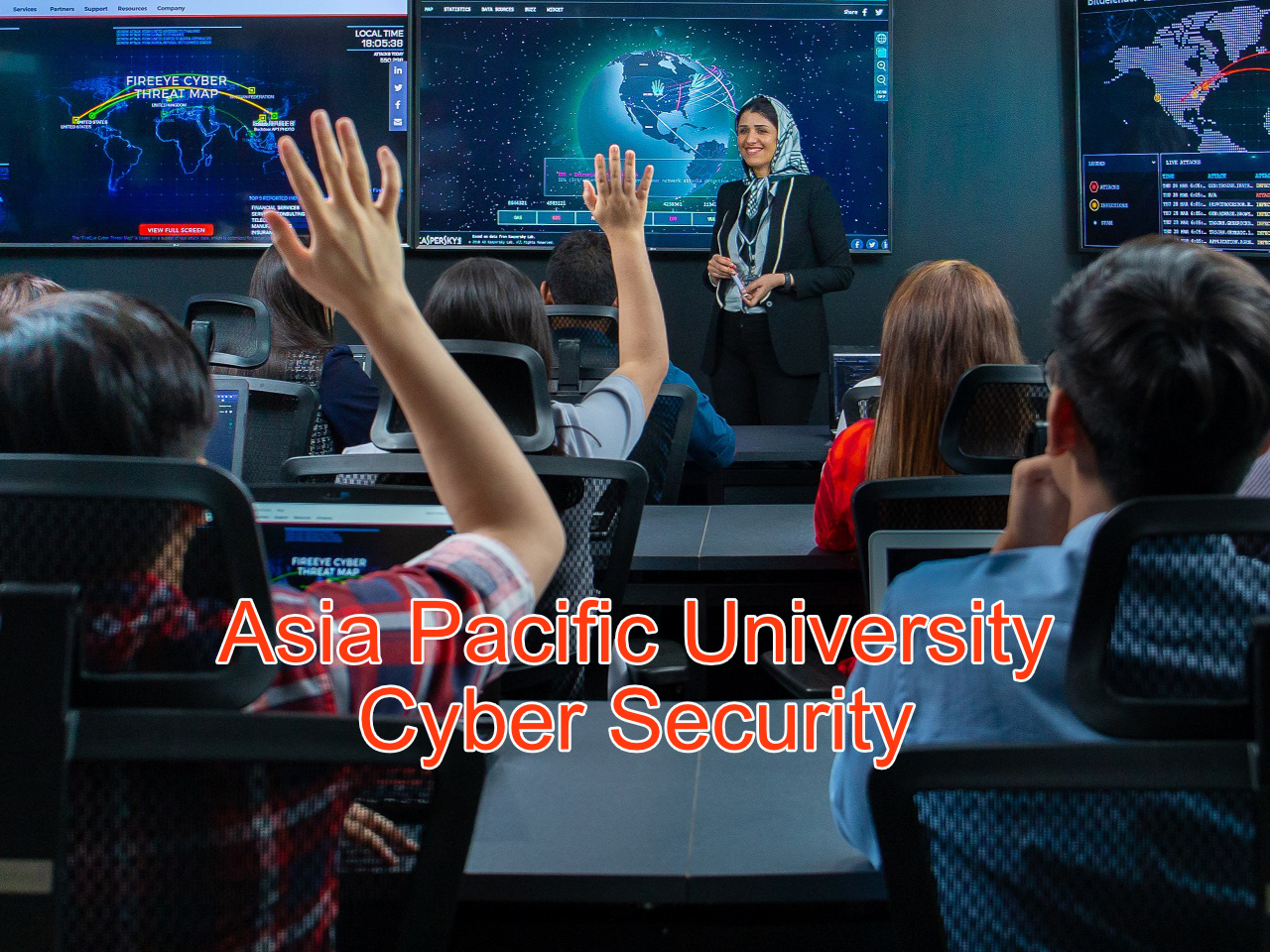
The full-fledged Cyber Threats Simulation and Response Centre (also known as Cyber Range) and Security Operations Centre (SOC) stream live monitoring data extracted from a database of cyber-attacks worldwide, providing a platform for hands-on practice when it comes to ethical hacking and incident response.APU also houses state-of-the-art infrastructure to complement the delivery of the curriculum.
In 2018, APU launched the nation’s first CyberSecurity Talent Zone, which is now home to military-grade real-time cyber security monitoring systems, research centres and simulation infrastructure to nurture global cybersecurity, networking and IoT talents of the future.
Based on real-time data, APU students learn to monitor, troubleshoot, investigate and escalate security breach issues. These experiences nurture security professionals who are ever-ready to join the cyber security workforce with their practical and technical exposure.
LEVEL 1 Subjects for the BSc. (Hons) Computer Science (Cyber Security) Degree course at Asia Pacific University (APU)

Jeremy Lee, Software Engineering Graduate from Asia Pacific University (APU)
Students will learn fundamental skills required by every IT professional, and the basic understanding of programming, mathematical and algorithmic skills.
A sound grasp of mathematical techniques and skills in algorithmic thinking are important pre-requisites for their second and third year studies in this area. Computer architecture, operating systems, networks, databases, security and forensic technologies are the underlying platforms in cyber security.
Introduction to management introduces the third key area, understanding personal and organisational development, along with independent learning and team working skills.
Common Modules
- System Software and Computing Concepts
- Introduction to Networking
- Introduction to Databases
- Python Programming
- Digital Thinking and Innovation
- Systems Analysis & Design
- Mathematical Concepts for Computing
- Integrated Computer Systems
- Fundamental of Entrepreneurship
Specialised Modules
- Introduction to Security and Forensic Technologies
ELECTIVE MODULES (CHOOSE 1)
- Introduction to Artificial Intelligence
- Introduction to Object-Oriented Programming
- Intercultural Awareness and Cultural Diversity
LEVEL 2 Subjects for the BSc. (Hons) Computer Science (Cyber Security) Degree course at Asia Pacific University (APU)
Vincent Lim, Software Engineering Graduate, Asia Pacific University (APU)
A broader range of skills will be learnt, in which students will gain better understanding in Cyber Security related areas. The students should be flexible in performing a range of computing tasks using extended theories and practice related to Cyber Security.
In the second year, the core modules deepen the understanding of platform technology, while specialised modules allow them to go further into system & network administration, computing theory, computer systems & low level techniques and implementation of secure systems.
Common Modules
- System Development Methods
- Object Oriented Development with Java
- System & Network Administration
- Innovation Process
- Research Methods For Computing & Technology
- Computing Theory
- Web Application
- Human Computer Interaction
- Data Structure
Specialised Modules
- Practical CTF Strategies
- Switching and Routing Essential
Elective Module (Choose 1)
- Ethical Hacking and Incident Response
- Implementation of Secure Systems
INTERNSHIP (16 WEEKS)
Students will undertake a short Internship/ Industrial Training for a minimum period of 16 weeks to prepare them for a smooth transition from the classroom to the working environment
LEVEL 3 Subjects for the BSc. (Hons) Computer Science (Cyber Security) Degree course at Asia Pacific University (APU)

Zen Yi, Graduated from Software Engineering at Asia Pacific University (APU)
Students will draw on their previous studies and industrial experience to refine their personal and professional development in the field of computer science majoring in Cyber Security.
Students will move further into Cyber Security by learning the core and specialised modules to enhance new skills and advanced knowledge on the current and future technologies.
Elective modules are offered to strengthen their essential skills and knowledge. A final year project requires them to investigate and develop a solution for a real world problem. They will demonstrate the ability to combine technical knowledge, critical thinking, and analytical skills to produce personal achievement portfolio.
Common Modules
- Project Management
- Algorithmics
- Deep Learning for Intrusion Detection
- Venture Building
- Advanced Software Security
- Advanced Database Systems
Specialised Modules
- Investigations in Cyber Security
- Vulnerability Assessment and Penetration Testing
- Advanced Cyber Security
- Project in Cyber Security
Elective Modules (Choose 1)
- Cloud Infrastructure & Services
- Internet of Things: Concepts & Applications
MQA Compulsory Subjects
- Appreciation of Ethics and Civilisation (M’sian Students)
- Malay Communication Language (Int’l Students)
- Philosophy and Current Issues
- Workplace Professional Skills
- Integrity and Anti-corruption
- Co-Curriculum
(*All students are required to successfully complete the General Studies modules as stipulated by the Malaysian Qualification Agency upon graduation)
Entry Requirements for the BSc. (Hons) Computer Science(Cyber Security) Degree course at Asia Pacific University (APU)
| GENERAL REQUIREMENTS | |
| DIRECT ENTRY TO LEVEL 1 OF THE DEGREE: | |
| STPM | • 2 Passes in STPM in Science stream with minimum Grade C (GPA 2.0) in Mathematics and one Science or ICT Subject. OR • 2 Passes in STPM with minimum Grade C (GP 2.0) in any subject with a credit in Additional Mathematics at SPM. OR • 2 Passes in STPM with minimum Grade C (GP 2.0) in any subject with a credit in Mathematics and any one Science or ICT subjects at SPM. Candidates need to do a Pre-Requisite module in Further Mathematics or equivalent in the first semester of Degree Programme. |
| A-LEVEL Overseas qualification that are equivalent to 12th Grade/A Level/HSC are accepted. |
• 2 Passes in A-Level in Science stream with a Pass in Mathematics and one Science or ICT subject. OR • 2 Passes in A-Level with a Credit in Additional Mathematics at SPM/IGCSE/O-Level or equivalent. OR • 2 Passes in A-Level with a Credit in Mathematics and Science or ICT subjects at SPM/O-Level/IGCSE or equivalent. Candidates need to do a Pre-Requisite module in Further Mathematics or equivalent in the first semester of Degree Programme. |
| UEC | • 5 Grade B Passes in UEC in any subject including Mathematics and one Science or ICT subject. • 5 Grade B Passes in UEC in any subject including Additional Mathematics. • 5 Grade B Passes in UEC in any subjects with Credit in Mathematics and Science or ICT Subject at SPM or equivalent. Candidates need to do a Pre-Requisite module in Further Mathematics or equivalent in the first semester of Degree Programme. |
| FOUNDATION/ MATRICULATION |
• A pass in Matriculation or Foundation studies with minimum CGPA of 2.0 with a Credit in Additional Mathematics at SPM/IGCSE/O-Level or its equivalent.
Note: The requirement for the Additional Mathematics can be exempted if the Matriculation or Foundation offers Mathematics module which is equivalent or higher requirement than the Additional Mathematics at SPM level.
OR |
| DIRECT ENTRY TO LEVEL 2 OF THE DEGREE: | |
| ICT RELATED DIPLOMAS | • Diploma with a minimum CGPA of 2.50.
Note: Student with CGPA above 2.0 and below 2.5 may be accepted using rigorous assessment conducted by APU and subject to the approval of the Academic Board.
|
Any qualification that APU accepts as equivalent to the above.
The above entry requirements may differ for specific programmes based on the latest programme standards published by Malaysian Qualifications Agency (MQA). The qualification and entry requirements for the programmes will be determined based on the “Comparison List of Equivalency of International Qualifications with SPM (O-Levels equivalent) and STPM (A-Levels equivalent)” published by Malaysian Qualifications Agency (MQA).
Career Options for Cyber Security Graduates from Asia Pacific University (APU)

Jia Chong, Diploma in IT (Software Engineering) at Asia Pacific University (APU)
- Cyber Security Engineer / Architect
- Cyber Security Consultant / Specialist
- Cyber Security Incident Response Analyst
- Security Operations Center (SOC) Analyst
- Intrusion Detection Analyst
- Cyber Threat Intelligence Advisor
- Ethical Hacker / Penetration Tester
- Secure Applications Engineer
- Information Security Analyst / Engineer
- Information Security Technical Specialist
- Computer Engineer
- Systems Engineer
- Software Developer
- Cyber Security Governance & Compliance Manager
- Chief Technology Officer (CTO)
- Chief Information Security Officer (CISO)
Top 10 Reasons to Study Computer Cyber Security at Asia Pacific University (APU) Malaysia
1. Malaysia’s Award-Winning Cyber Security University – Asia Pacific University (APU)
Asia Pacific University (APU) has won more than 200 awards in the area of technology locally as well as globally.
To win an award is proof that a student has reached a level of capability as well as the quality of the lecturer that has taught and guided the student in the competition.
Additionally, APU’s cyber security students have been excelling in local and international cyber-related competitions.
Moreover, APU has produced digital security superstars, who constantly outperform their peers at national and international level competitions.
2. Technologically Advanced Cyber Security Labs at Asia Pacific University (APU)
State-of-the-art infrastructure at APU’s CyberSecurity Talent Zone allows students to have real-life exposure within the university’s environment.
With the support of industry partners and Malaysia Digital Economy Corporation (MDEC), APU continuously responds to the talent demand as they aspire to train and nurture “superheroes” of the digital space who will combat digital crimes and safeguard digital assets when they graduate.
The nation’s first state-of-the-art infrastructure and sophisticated learning space – CyberSecurity Talent Zone (CSTZ) – incorporates military-grade real-time cybersecurity monitoring systems, research centres and simulation infrastructure.
The full-fledged Cyber Threats Simulation and Response Centre (also known as Cyber Range) and Security Operations Centre (SOC) stream live monitoring data extracted from a database of cyber-attacks worldwide, providing a platform for hands-on practice when it comes to ethical hacking and incident response. APU also houses state-of-the-art infrastructure to complement the delivery of the curriculum.
In 2018, APU launched the nation’s first CyberSecurity Talent Zone, which is now home to military-grade real-time cyber security monitoring systems, research centres and simulation infrastructure to nurture global cybersecurity, networking and IoT talents of the future.
Based on real-time data, APU students learn to monitor, troubleshoot, investigate and escalate security breach issues. These experiences nurture security professionals who are ever-ready to join the cyber security workforce with their practical and technical exposure.
Upon completion of 50 hours manning the SOC and successfully completing all activities in an assessment, students get a certificate of completion from APU’s industry partner TecForte.
3. Industry Advisory Panel
Industry advisory panel consisting of experts from the cyber security field – CompTIA, ISACA, CSM, MDEC, TecForte, Cyber Test Systems, Cyber Intelligence and SecureKi – are involved in designing the curriculum at APU, ensuring the syllabus taught is up-to-date and relevant for students to change and improve the landscape of secure computing.
4. 100% Employability
“100% Employed by Graduation” – Graduate Tracer Study 2018 – According to the latest Annual Graduate Tracer Study by Ministry of Education Malaysia, 100% of APU graduates were employed by graduation in 2018.
Malaysia Digital Economy Corporation chief executive officer Datuk Yasmin Mahmood said in Asia Pacific University (APU), there is a 300% employability rate for cybersecurity students, with them getting two or three job offers as cybersecurity professionals before they graduated.
5. Premier Digital Tech University status
APU was awarded the Premier Digital Tech University status by the Malaysia Digital Economy Corporation (MDEC).
APU is recognised for its commitment in offering top-notch digital technology courses and ensuring our highly-skilled graduates continue to flourish and fill future digital job demands locally and globally.
This status was awarded by the Minister of Higher Education Malaysia in 2017. In June 2019, this status has been renewed for a further 3 years by MDEC.
6. QS Stars Rating 2017
5-STARS for APU at QS Stars Rating 2017 -Asia Pacific University (APU) received international recognition by Quacquarelli Symonds (QS) in 2017 with APU being awarded 5-Star in four categories of the QS Stars Rating – Teaching, Employability, Facilities and Inclusiveness. The QS Stars rating measures achievements of universities worldwide.
QS Stars is a international rating system which allows students to better understand an institution’s qualities, looking at everything from the employability of graduates, to sports facilities and community engagement.
7. Industry-Academia Collaboration (IAC) model
APU follows a structured Industry-Academia Collaboration (IAC) model that associates the concerned parties involving industry, academia, and government. The main considerations include enhancing the employability of graduates, necessary information on the employability outlook, areas of growth within the ICT industry and how various programmes offered by APU assist in talent development.
8. Asia Pacific University (APU) has a Truly International Community – 11,000 Students from over 110 Countries
With an international student community of more than 11,000 students from more than 110 countries studying in its Malaysian campus, APU offers a truly cosmopolitan learning environment which prepares students well for the global challenges which lie ahead. APU offers a wide range of degrees with Technology as a common core.
It is APU’s aim to nurture and encourage innovation through our programmes, with the intention of producing individuals who will learn, adapt and think differently in new and better ways.
9. Recognition of Asia Pacific University (APU) Courses in Malaysia
Besides, being awarded the MSC Malaysia status for Institutions of Higher Learning is a recognition and testimony of APU’s contribution to Malaysia’s Digital Economy through IT professionals with industry relevant and immediately employable skills upon graduation.
In 2017, APU is also recognized as one of the Premier Digital Institute of Higher Learning (IHL) by the Malaysia Digital Economy Corporation (MDEC), in which the university is now open to more opportunities from the government and the industry through exclusive collaborations, internship and job placements etc.
APU’s academic programmes are approved by the Ministry of Education of Malaysia and the qualifications are accredited, or provisionally accredited by the Malaysian Qualifications Agency (MQA). This means that the courses at APU are recognised worldwide for employment.
10. Opportunity to Participate in Competitions
It costs money to participate in competitions, meaning that APU has invested money for her students to gain invaluable experience through these important events. As a student of APU, you will have the opportunity to participate in competitions if you are good and should you win, it will add value to your resume. Future employers will look favorably to outstanding students with top academic knowledge and practical experience.
Some notable achievements specific to Cybersecurity include the
- ASEAN CYBER SEA GAMES
- 2023 – 4th Place
- PROJECT MANAGEMENT INSTITUTE, MALAYSIA CHAPTER (PMIMY) HACKATHON
- 2023 – Overall Winner and 1st Runner Up
- GAME OF HACKERS
- 2023 – 1st Runner-Up and 3rd Runner Up
- INTERNATIONAL OCEAN HACKATHON
- 2023 – 3rd Place (Ocean Hackathon International Grand Finale 2023, Brest, France)
- 2023 – Champion (Ocean Hackathon Kuala Lumpur)
- 2023 – Top 10 (Ocean Hackathon Maldives)
- BLUE TEAM CYBER SECURITY CHALLENGE 2023 (WITH KC7)
- 2023 – First Place
- HACKTITUDE MALAYSIA
- 2023 – Champion
- CYBERSECURITY EXCELLENCE AWARDS
- 2023 – Gold Winner (Best CyberSecurity Education Provider in Asia)
- 2022 – Gold Winner (Best CyberSecurity Education Provider in Asia)
- 2021 – Gold Winner (Best CyberSecurity Education Provider in Asia)
- 2020 – Gold Winner (Best CyberSecurity Education Provider in Asia)
- 2019 – Gold Winner (Best CyberSecurity Education Provider)
- MICROSOFT’S CODE; WITHOUT BARRIERS HACKATHON
- 2023 – Winners
- IMPACTHACK BY STANDARD CHARTERED
- 2023 – Champion
- ETHEREUM BLOCKCHAIN HACKATHON AT ETH SEOUL 2023
- 2023 – Best Governance App Winner
- UNIVERSITI MALAYA (UM) HACKATHON
- 2023 – 2 Champions
- WICKED 6 CYBER GAMES, 2023 WOMEN’S GLOBAL CYBER LEAGUE
- 2023 – 1st Place in Women’s Society of CyberJutsu (WSC) CTF
- 2023 – 2nd Place in the Haiku CTF and Security Innovation CTF
- 2023 – 7th Place in the SANS Bootup CTF
- 30-HOUR NO-CODE HACKATHON
- 2023 – First Place Winner
- MYSTARTUP HACKATHON X DIGITAL NASIONAL BERHAD (DNB)
- 2023 – Problem Statement 3 Winner
- I-HACK COMPETITION
- 2022 – 4th Place
- 2022 – 6th Place
- 2022 – 7th Place
- 2016 – Champion (Forensic Challenge)
- 2016 – Champion (Hack & Defence)
- BATTLE OF HACKERS (BOH)
- 2022 – 1st Runner Up
- 2022 – 3rd Runner Up
- 2021 – Champion
- 2021 – Top 6
- 2021 – Top 7
- 2021 – Top 8
- ODYSSEY HACKFEST: ONLINE CATEGORY
- 2022 – Champion
- ASEAN MAKEITSAFE HACKATHON
- 2022 – 1st Runner Up
- VARSITY HACKATHON ORGANISED BY UNIVERSITI SAINS MALAYSIA (USM)
- 2022 – 4th Place and 8th Place
- RHB GET YOUR HACK ON: DATA EDITION
- 2022 – Winner of AWS Special Award
- KARUNA HACKWND
- 2021 – 1st Place & 3rd Place in the Mobile Application Category
- FUSION UX-HACKATHON
- 2021 – 1st Place & Gold Award
- 2021 – Silver Award
- 2021 – Bronze Award
- F-SECURE MDEC CYBERSECURITY COMPETITION
- 2021 – 2nd Runner Up
- 2021 – Top 6
- XYLEM REACH STUDENT HACKATHON
- 2021 – 1st Prize Winner
- THE AWS HACKATHON BUILD ON MALAYSIA
- 2021 – Champion
- 2021 – 1st Runner Up
- 2021 – 2nd Runner Up
- 2020 – Champion
- 2020 – Best Innovation Award
- F-SECURE INTERVARSITY CYBERSECURITY CHALLENGE
- 2020 – Champion
- 2018 – Champion
- 2018 – 2nd Place
- 2017 – Champion
- 2016 – Champion
- GLOBAL CLIMATE HACK COMPETITION
- 2021 – 3rd Place
- 2021 – People’s Choice Award
- GLOBAL CLIMATE HACK COMPETITION
- 2021 – 3rd Place
- 2021 – People’s Choice Award
- REGIONAL CYBER CHALLENGE (RCC)
- 2019 – Champion
- 2019 – 1st Runner Up
- “PWN TILL DAWN” HACKATHON BY WIZLYNX GROUP
- 2019 – 4th Place
- 2019 – 5th Place
- 2019 – 6th Place
- Top University Award at the KPMG Cyber Challenge 2018
- KPMG CYBER SECURITY CHALLENGE
- 2019 – 1st Runner Up
- 2018 – Top University Award
- 2018 – Champion (“APT, Malware & Cyber powered by FireEye” track)
- 2018 – Champion (“Engineering & Cyber – powered by IET” track)
- 2018 – 2nd Runner Up (Cyber Security Challenge 2018 – National Finals)
- Champion of the Ernst & Young Asia-Pacific Global Hackathon 2019
- CYBER HEROES COMPETITION
- 2019 – Champion
- 2019 – Most Valuable Player (MVP)
- 2017 – 3rd Place
- 2017 – 4th Place
- Three times champion at the F-Secure Intervarsity Cyber Security Challenge since 2016
- HACKING, DEFENCE AND FORENSICS COMPETITION 2018 Champions
- APPRENTICE INNOVATION & RESEARCH EXHIBITION (AIREX) 2018 Champions
- HACK@10 CYBERSECURITY COMPETITION
- 2018 – Champion
- 2018 – 2nd Runner Up
- 2018 – 10th Place
- 3rd Place in the 2018 “HACK FOR GOOD” CHALLENGE
- 1st Place in the 2016 JOM HACK: SMART CITIES WITH LORA
- GAMIFICATION HACKATHON
- 2016 – Champion
- 2016 – Gold Medal
- Grand Prize Winner in the 2016 ANGELHACK GLOBAL HACKATHON (MALAYSIA)
- I-HACK
- 2016 – Champion (Forensic Challenge)
- 2016 – Champion (Hack & Defence)
- UTP-HAX NATIONAL HACKING COMPETITION
- 2015 – 1st Runner-up
- 2014 – 1st Runner-up
- 2014 – 4th Place
- 2014 – 1st Runner-up
- MALAYSIA CYBERSECURITY AWARDS (CYBERSECURITY MALAYSIA)
- 2013 – Award for ‘Information Security Training Provider of the Year’
- 2012 – Award for ‘Information Security Training Provider of the Year’
- 2009 – Award for ‘Information Security Training Provider of the Year’
- HSBC YOUNG IT ENTREPRENEUR AWARDS 2004 – Judges Award for ‘Security Transmitter & Detector’ device