


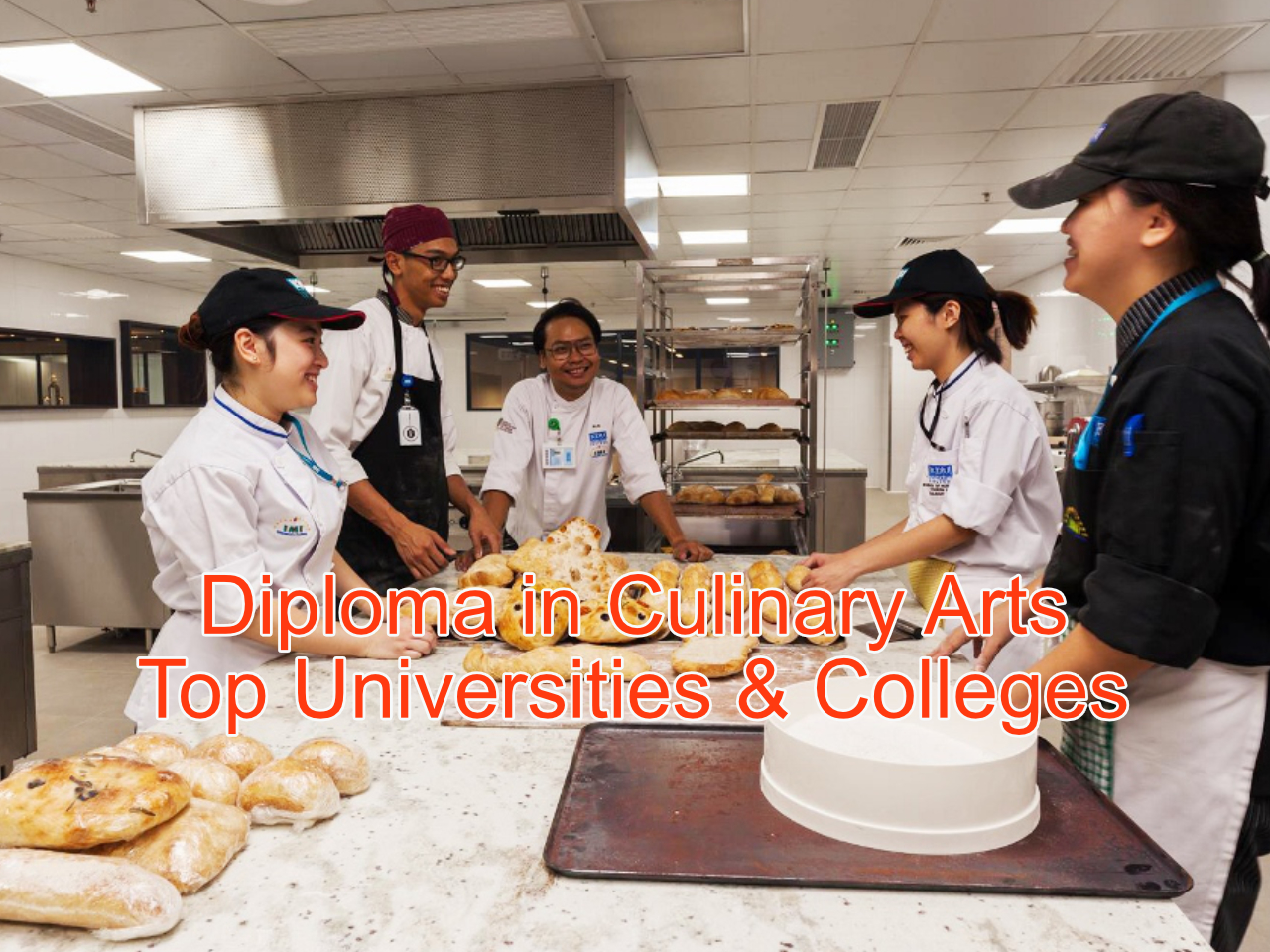
A Look at the Best Universities to Study the Culinary Arts Diploma in Malaysia
Preparing delicious dishes & pastries are just a few of the skills that you can learn at a top culinary school in Malaysia. A culinary program can help prepare you for a great career as a chef, baker, wine steward or restaurant owner. The skills you develop as you train to be a chef are vital for future success in the culinary world. Culinary arts students should develop a strong understanding of how the abilities they hone in the classroom transfer to professional kitchens across the globe will be invaluable to their career advancement.
A diploma in culinary arts course at a private college or university in Malaysia is 2.5 years in duration and includes a semester for internship. The diploma is more practical in nature with about 60% practical.Most culinary art schools in Malaysia teach a variety of cuisines and preparation techniques. Instruction ranges from the fancy haute French style cuisine to Italian style cuisine or Asian fusion styles. Students will learn the basics of kitchen and cooking techniques, business subjects, planning a menu and managing a restaurant.
The diploma should be accredited by the Malaysian Qualifications Agency (MQA) so that you can continue on to a degree. Some colleges offer “diplomas” from other countries which are not accredited by MQA and not recognised by the Malaysian universities for degree studies. A knowledgeable and experienced counsellor would be able to guide you to the right choice.
Enrolling in any college course can be challenging. However, when you are passionate about what you want to do in the future, you may be surprised at how easy the choice can be. Diploma in Culinary Arts courses are available to help you go from cooking at home to owning your own restaurant in one of the largest cities in the world as long as you choose a top college. Future success is only one of the many benefits to enrolling in top culinary arts diploma courses.
Where to Study the Diploma in Culinary Arts in Malaysia?

Wei Kang,
Culinary Arts Graduate from UOWM KDU
The best culinary schools in Malaysia pride themselves on their facilities. Students get hands-on experience in kitchens equipped with the latest technology and equipment. Many of these schools also have their own restaurants, patisseries, or cafes on campus, where students can get real-world experience and showcase their skills to the public.
Choosing a private university that excels in your field of study may provide you with access to more specialised opportunities, including custom-built facilities such as Fine dining restaurant, Training restaurant, Preparation kitchen, Production kitchen, patisserie kitchens, Butchery Kitchen, Atelier or Artistry kitchen. In addition, the university will be able to provide culinary arts-specific academic opportunities like student mobility programmes or overseas study trips) as well as employment or internships opportunities with top establishments in Food & Beverage. If your university excels in your field, it’s also likely that you will be taught by prominent and experienced chefs, and that there will be opportunities for you to learn from industry experts.
Choosing the best university for your studies in Malaysia is important as it will help to shape your mind, character and help you to develop the necessary skills for a successful career in the competitive Food & Beverage industry. Therefore, not all private universities & colleges in Malaysia are the same. You should not choose a university because it is the cheapest, easiest and nearest. It should be based on which university that best fits your needs. While it can be difficult to choose between private universities or colleges in Malaysia offering the diploma in culinary arts, you will find that there are some key differences between them that can help you make the big decision in choosing the right one that fits you.
Which are the Top Institutions Offering the Culinary Arts Diploma?
Choosing the best university for your studies in Malaysia is important as it will help to shape your mind, character and help you to develop the necessary skills for a successful career in the competitive Food & Beverage industry.
Here are 10 Top Culinary Schools in Malaysia for you to compare:
- Taylor’s University
- UOW Malaysia
- UOWM KDU Penang
- YTL International College of Hospitality Management (YTL-ICHM)
- Berjaya University College
- Sunway University
- INTI International College
- Nilai University
- TARUMT
- UCSI University
Which Diploma is Best to Become a Chef?

Fu Wei, Diploma in Culinary Arts Graduate from YTL International College of Hotel Management
The culinary industry is ideal for students who possess a flair for creativity, desire to please peoples’ palates, provide solutions, able to handle pressure, entrepreneurs and a passion for cooking.
Students who are sure of pursuing a career in this exciting and rewarding field may go for the Diploma in Culinary Arts at a Private University in Malaysia. It is important to go for a recognised and accredited Diploma programme in order to pursue your degree later on or to find work overseas.
The Diploma in Culinary Arts programme at a top Private University will enhance your supervisory, technical and personal skills. It will also broaden your creativity, as communication and problem-solving skills are essential in the culinary arts industry.
It is designed for those who have chosen to pursue an exciting career in culinary arts. This unique skills-driven programme takes you through key stages of classical and international cuisine preparation, garde manger, butchery, patisserie and bakery. In addition, students will also learn about the business part of culinary arts with subjects like marketing, accounting, and entrepreneurship.
The culinary arts programme begins with an orientation level course where you are introduced to topics such as basic culinary, kitchen hygiene, nutrition, baking, pastry, kitchen layout and design. After mastering the basics, the programme will then focus on advanced-level food preparation which includes, cooking and plating whole dishes and pastries to perfection.
To succeed in the Food & Beverage industry, the first step after secondary school is to go for the Diploma in Culinary Arts at a reputable private university.
What Qualifications Do I Need to Join a Diploma in Culinary Arts Course?
Students after SPM or IGCSE/O-Levels with a minimum of 3 credits can go for the Diploma in Culinary Arts for 2.5 years before entering into Year 2 of the Degree programme for another 2 years.
- SPM – Minimum 3Cs in any subject with passes in BM and Sejarah
- IGCSE/O-Levels – Minimum 3Cs in any subject
- UEC – Minimum 3Bs in any subject
How much is the cost of a Diploma in Culinary Arts in Malaysia?
The tuition fees for a Diploma in Culinary Arts can be expensive because of the facilities. It will range from RM40,000 to RM60,000 for a 2.5-year course.
Students must be careful not to choose the cheapest college to study as they may not have the facilities to support your learning experience therefore when you go out to work you would not be familiar with the technologically advanced equipment and kitchen facilities.
Tuition fees for the diploma in culinary arts would range from RM40,000 to RM60,000 total for the 2.5-year course. Outstation students will need to take into consideration the cost of living and accommodation.
What Facilities will I use for Culinary Arts at the University or College in Malaysia?

Desmond, Culinary Arts at KDU University College
It is important for the college or university to have the necessary culinary arts facilities so that you can gain the necessary skills in your culinary education. The university or college doesn’t necessarily need to have all the facilities needed but should have the basic ones.
Students should ensure that the Culinary School has a complete infrastructure with state-of-the-art facilities which may include lecture theatres, classrooms and seminar rooms, conference room, learning and resource centre for their academic lessons.
Culinary facilities should cover fully equipped preparation, production and pastry kitchens, bakery, culinary studio, culinary theatre, show kitchen, fine dining restaurant, oenology laboratory and chocolate and sugar artistry laboratory among others.
- Fine dining restaurant – Built to mimic a true fine dining restaurant, students are given real practice
- Training restaurant – Training Restaurant – students run everything from scratch while serving real customers and countering real-time situations.
- Preparation kitchen
- Production kitchen
- Bakery, pastry or patisserie kitchens
- Butchery Kitchen – students learn and master the techniques and skills to create various deli products.
- Atelier – Hot Kitchen
- Garde manger kitchen
- Artistry kitchen – students are trained to master the most delicate of arts.
- Molecular Gastronomy Lab
- Sugar artistry laboratory
- Chocolate Room
- Culinary Lecture Theatre – Top notch facilities equipped in the theatre allows for in-class demonstrations.
- Ice Carving Lab – students are taught first hand on the art of ice carving.
- Wine Laboratory (oenology laboratory) – Students are given a holistic education complemented with our state-of-the-art facilities inclusive of a wine tasting lab.
What is the Academic Outcomes of the Culinary Arts Diploma?

Zi Jun & Yung Cong, Diploma in Culinary Arts at YTL International College of Hotel Management
The 2-year Diploma in Culinary Arts programme is designed to equip students who wish to pursue culinary arts with fundamental skills in culinary arts and strong product knowledge, as well as the ability to perform and organise food production.
Unlike a culinary arts academy, the curriculum focuses on the areas of culinary, pastry as well as culinary management. Students are trained to develop a high degree of professionalism during the culinary arts course, focusing on quality of the food.
- Equipped with technical skills in kitchen setup and organisation, food product knowledge, patisserie and artistic skills.
- Exposure to different cooking techniques in Western and Asian cuisine, training students to be experts in the field of hot cooking, pastry, baking as well as butchery and garde manger.
- Trained to achieve a high degree of professionalism and to focus on the quality of the product and customers’ expectations
What are the subjects that you will study in a Diploma in Culinary Arts

Kar Wai, Diploma in Culinary Arts at YTL International College of Hotel Management
- Food Hygiene & Sanitation
- Introduction to Pastry & Bakery
- Fundamental of Culinary
- Fundamentals of Food & Beverage
- Patisserie & Bread Confections
- Essential Cuisine Techniques
- Fundamentals of Marketing
- Business Mathematics
- Food & Beverage Service
- Asian Desserts & Breads
- Business Accounting
- Ergonomics & Work Environment
- Plated Desserts & Artistic Skills
- French, Italian or Asian Cuisine
- Foodservice Business Plan
- Entremet & Artistic Skills
- Advanced Cuisine
- Principles of Purchasing
- Advanced Bakery & Pastry Arts
- Culinary Essentials
- Culinary Artisting & Design
- Entrepreneurship Studies
- Food, Beverage & Labour Cost Controls
- Food Nutrition, Sanitation & Safety
- Food Services Operations
- International Cuisine
- Introduction to Hospitality Operations
- Introduction to Patisserie skills
- Menu Design & Development
- Principles of Garde Manger
- Professional Development & Planning
- Advanced Butchery
- Chocolates & Confections
- Classical French Cuisine & Service
- Commodity Cooking
- Hospitality Facility, Layout & Design
- Molecular Cuisine
How long is the Diploma in Culinary Arts Course?
A Diploma in Culinary Arts will take you 2.5 years to complete including an internship.
Internship
Students will undergo a 16-week internship in the kitchen and restaurants to develop practical and relevant skills.
How is the Diploma in Culinary Arts Assessed?
The assessments for a diploma programme at private universities and colleges in Malaysia is a mix of Assignments, Coursework, and written examination percentage. The diploma programme provides students with relevant, interesting, stimulating and practical experience via a variety of teaching and practical techniques.
Accreditation & Recognition for the Diploma in Culinary Arts Courses
Zi Jun & Yung Cong, Diploma in Culinary Arts at YTL International College of Hotel Management
When choosing a diploma programme, students will need to ensure that the course is accredited by the Malaysian Qualifications Agency (MQA) and that the institution is recognised by the Ministry of Education. Students should be wary of colleges or academies offering “diploma” courses awarded by unknown UK, USA or Australian universities that’s not accredited by MQA.
Upon completion of these diploma programmes, you will not be able to continue on to degree programmes at Malaysia’s universities.
The Malaysia Qualifications Agency (MQA) is an official body that is governed by the Ministry of Higher Education and is the only body that controls universities’ accreditation status, regulate curriculum and set operational standards for both public and private universities and other higher learning institutions in Malaysia. MQA also accredit individual courses and programmes at each university. MQA’s operation is important because it works to ensure that higher learning in the country is up to global standards and is fit for the future of the nation.
Accreditation is a formal recognition that a certificate, diploma or degree programme has attained the quality standards and criteria set by MQA and is in compliance with the MQF.
PTPTN Loan Available for Diploma in Culinary Arts Courses
Students may apply for the PTPTN Loan for Diploma courses. There is no PTPTN Loan for Foundation & External Pre-University programmes.
The PTPTN Loan is offered by the Malaysian government to help students in their Diploma and Degree studies at private universities and colleges. The Perbadanan Tabung Pendidikan Tinggi Nasional, is an agency under Malaysia’s Ministry of Education that provides educational financing for students.
The amount of loan that students can apply for will depend on the household income. This means the income of both parents combined.
|
Education Level for Private Universities or IPTS |
Household Income | ||
<RM4,000MAKSIMUM(RM) |
<RM8,00075%(RM) |
>RM8,00050%(RM) |
|
| Diploma | 6,800 | 5,100 | 3,400 |
The PTPTN loan is divided into three categories – full, partial and tuition fees only. The amount of the loan is determined by the applicant’s monthly household nett income and number of dependants.
| Category of Education Funding | Monthly Household Nett Income (RM)* |
|---|---|
| Full | Not exceeding 4,000 |
| Partial | More than 4,000 but not exceeding 5,000 |
| Tuition fees only | More than 5,000 |